Beginner guide
The BJJ belt system, explained
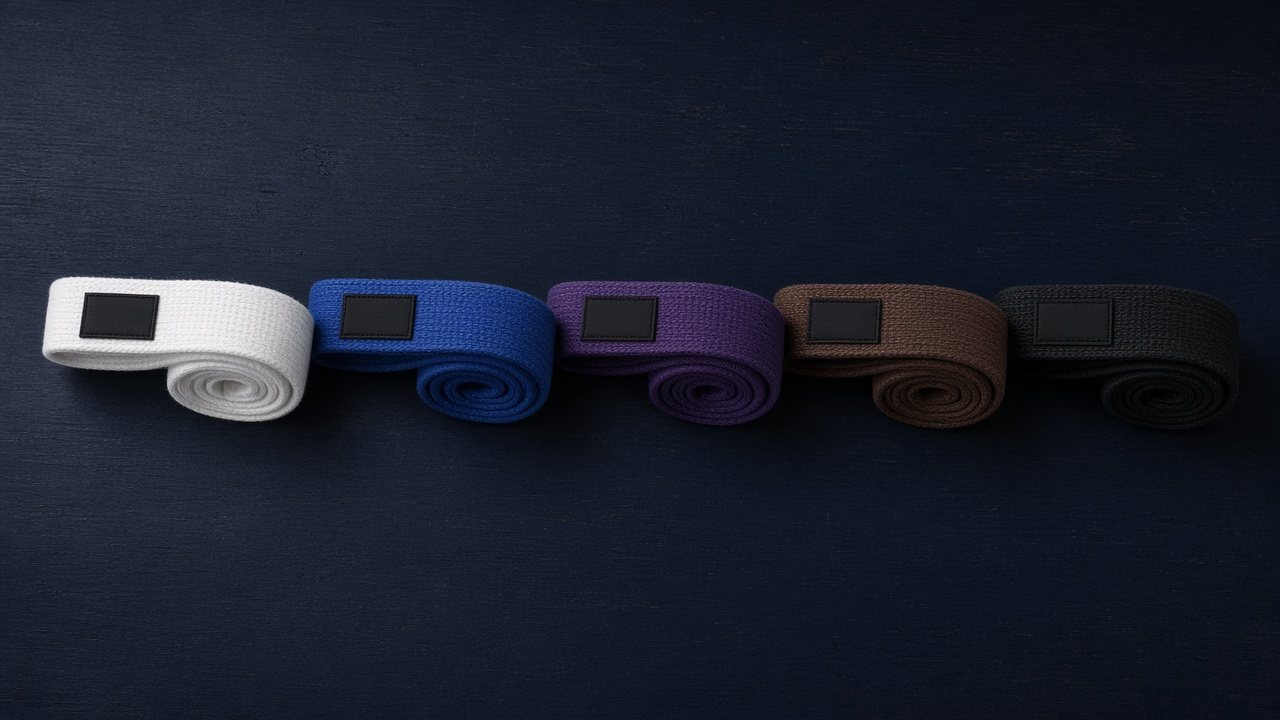
Image: generated for this site with AI; it does not show a real product, brand, or person.
Brazilian jiu-jitsu uses colored belts to mark rank. Belts are given by your instructor, not earned by a test with a fixed pass mark. Different schools and federations run it differently. This guide uses the International Brazilian Jiu-Jitsu Federation’s (IBJJF) published graduation system, the best-known one, as a baseline. A school does not have to follow the IBJJF, and the IBJJF’s numbers are minimums, not promises.
All figures here come from the IBJJF’s General Graduation System (June 2026 edition) and its summary pages, linked in the sources. They are for athletes registered with the IBJJF; your school may promote on its own timeline. The IBJJF can change these rules.
Adult belts (age 16 and up)
| Belt | Minimum age | Minimum time at this belt (age 18+) | Degrees (stripes) |
|---|---|---|---|
| White | Any age | No minimum | Plain belt plus up to 4 |
| Blue | 16 | 2 years | Plain belt plus up to 4 |
| Purple | 16 | 1.5 years | Plain belt plus up to 4 |
| Brown | 18 | 1 year | Plain belt plus up to 4 |
| Black | 19 (18 only for an Adult World Champion at brown belt) | Longer timelines; first degree after 3 years of verified activity | Up to 6 degrees |
Above black belt, the IBJJF also lists red-and-black, red-and-white, and red belts for master-level practitioners. Those carry age and time requirements of their own.
How to read the table
- Minimums, not schedules. The IBJJF says the periods are not fixed; each professor decides how long each student stays at each belt. Most people take longer than the minimum.
- Counted from IBJJF registration. The IBJJF counts time from the day the athlete is registered at each belt. If your school is not registered, that clock may not apply to you.
- Shorter minimums exist. For example, someone who held a gray, yellow, or orange belt as a child can have a shorter minimum at blue, and adult world champions have no minimum at blue, purple, or brown.
- Degrees are optional at lower belts. The IBJJF leaves use of the degree system up to each professor through brown belt. Schools often use stripes on the belt’s black bar to show progress between belts. How many a school uses is up to them.
Kids’ belts (ages 4 to 15)
Children use a separate set of belts. The IBJJF’s groups are white, then gray (ages 4–15), yellow (7–15), orange (10–15), and green (13–15). Each color group can have a white-striped version and a black-striped version in between. There is no minimum time at each belt for kids. At 16, a child moves into the adult system: gray, yellow, and orange belts become blue, and green becomes blue or purple at the professor’s decision.
What a belt does and doesn’t say
A belt is a rough signal of experience in a particular school. It is not a universal standard of skill; the same belt can mean different things in different places. A good use of the system for a new student is patience: the white belt stage has no minimum, and blue belt, the first big milestone, has a two-year minimum for adults under the IBJJF system. Rank is the instructor’s call. If you are curious about the criteria at your school, ask your coach.
New to jiu-jitsu and want to see how a class actually works? Read what to expect at your first class.
Sources
- IBJJF — Graduation system. The federation’s page on its graduation system and poster.
- IBJJF General Graduation System, June 2026 (Portuguese PDF). Belt colors, minimum ages, minimum times, degrees, and kids’ groups. Hosted by a Brazilian state federation.
- Gracie Laval — IBJJF graduation system explained. An English-language summary of the same system, used to cross-check the table.